

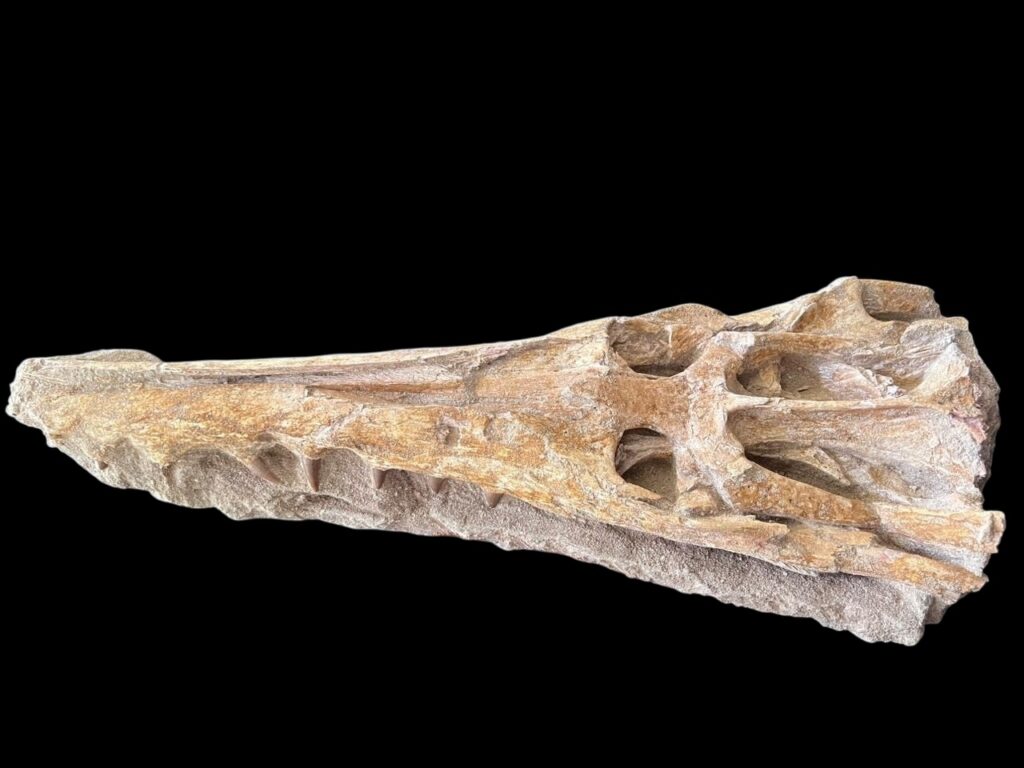
Dyrosaurus phosphaticus: The Ancient Marine Crocodile of Morocco’s Eocene Seas
Among the most fascinating prehistoric reptiles of North Africa is Dyrosaurus phosphaticus, a long-snouted marine crocodile that dominated the warm coastal waters of what is now Morocco around 60 million years ago, during the Lower Eocene. Known for its remarkable skull morphology and its ability to thrive in both marine and freshwater environments, Dyrosaurus stands as a key species in understanding early Cenozoic ecosystems.
A Survivor of the End-Cretaceous Extinction
Unlike many large marine reptiles that vanished at the end of the Cretaceous period, Dyrosaurus phosphaticus survived and adapted. Its presence in early Eocene layers makes it an important species for studying:
- Post-extinction recovery
- Marine reptile evolution
- Biodiversity patterns in early Cenozoic Africa
This resilience has made Dyrosaurus one of the most studied crocodilian genera from the Paleogene period.
Anatomy of a Marine Predator
The most striking feature of Dyrosaurus phosphaticus is its elongated, narrow skull, equipped with sharp conical teeth ideal for catching fish and other marine prey. Adult skulls could reach impressive sizes, and specimens from Morocco commonly measure between 60–80 cm.
Key anatomical characteristics include:
- Streamlined snout adapted for rapid jaw closure
- Interlocking teeth for gripping slippery prey
- A robust cranial structure built for life in coastal waters
- Sensory adaptations similar to modern crocodilians
These features reveal a predator well-adapted to shallow marine environments.
The Moroccan Phosphate Basins: A Paleontological Treasure
The phosphate mines of Khouribga and Oulad Abdoun are internationally renowned for their rich fossil beds spanning the Late Cretaceous to the early Cenozoic. These basins have produced some of the world’s most impressive vertebrate fossils, including:
- Mosasaurs
- Prehistoric sharks
- Sea turtles
- Early whales
- Crocodilians like Dyrosaurus phosphaticus
The exceptional preservation of the phosphate layers allows researchers to reconstruct a vivid picture of ancient marine ecosystems.
Scientific Importance of Dyrosaurus Fossils
Fossils of Dyrosaurus phosphaticus help paleontologists understand:
- The biogeography of early marine crocodiles
- The environmental shifts following the K-Pg extinction
- Predatory hierarchies in Eocene coastal waters
- The evolutionary link between ancient and modern crocodilians
A complete or semi-complete skull of this species is especially valuable due to its diagnostic features and the difficulty of recovering such fossils intact.
Interested in Owning an Authentic Dyrosaurus Skull?
For collectors, educators, and museums, a Dyrosaurus phosphaticus skull is a rare and scientifically important centerpiece.
Dyrosaurus phosphaticus: The Ancient Marine Crocodile of Morocco’s Eocene Seas
Among the most fascinating prehistoric reptiles of North Africa is Dyrosaurus phosphaticus, a long-snouted marine crocodile that dominated the warm coastal waters of what is now Morocco around 60 million years ago, during the Lower Eocene. Known for its remarkable skull morphology and its ability to thrive in both marine and freshwater environments, Dyrosaurus stands as a key species in understanding early Cenozoic ecosystems.
https://mizafoss.etsy.com/listing/4412411968/great-argochampsa-krebsi-crocodile-skull
https://mizafoss.etsy.com/listing/4412411968/great-argochampsa-krebsi-crocodile-skull